
Stud Wall Cut List Calculator
Plan studs, plates and noggins from standard CLS timber lengths with a stud wall cut list calculator. Get a kerf-aware purchase summary, choose the most efficient stock lengths, and export a clear cut plan for the workshop.
How to Build a Stud Wall Cut List
A stud wall cut list breaks the frame down into individual members (studs, top and bottom plates, and noggins), each with a length and quantity. Running that list through a cut list optimiser tells you which stock lengths to buy and how to cut them with the least waste.
- Measure the wall. Note the wall length and the floor-to-ceiling height.
- Calculate stud length. Subtract the combined plate thickness from ceiling height. For 47mm CLS plates and a 2400mm ceiling: 2400 − 94 = 2306mm per stud.
- Count the studs. Divide wall length by stud spacing and add one. For a 3600mm wall at 400mm centres: 3600 ÷ 400 = 9 bays, so 10 studs.
- Add plates. Two plates at wall length: top and bottom.
- Add noggins. One row at mid-height is typical. Noggin length = stud spacing minus stud thickness. At 400mm centres with 47mm CLS: 400 − 47 = 353mm each.
- Enter the list, set kerf, select stock lengths, and run. The optimiser returns a purchase summary and a cut plan ready for the workshop.
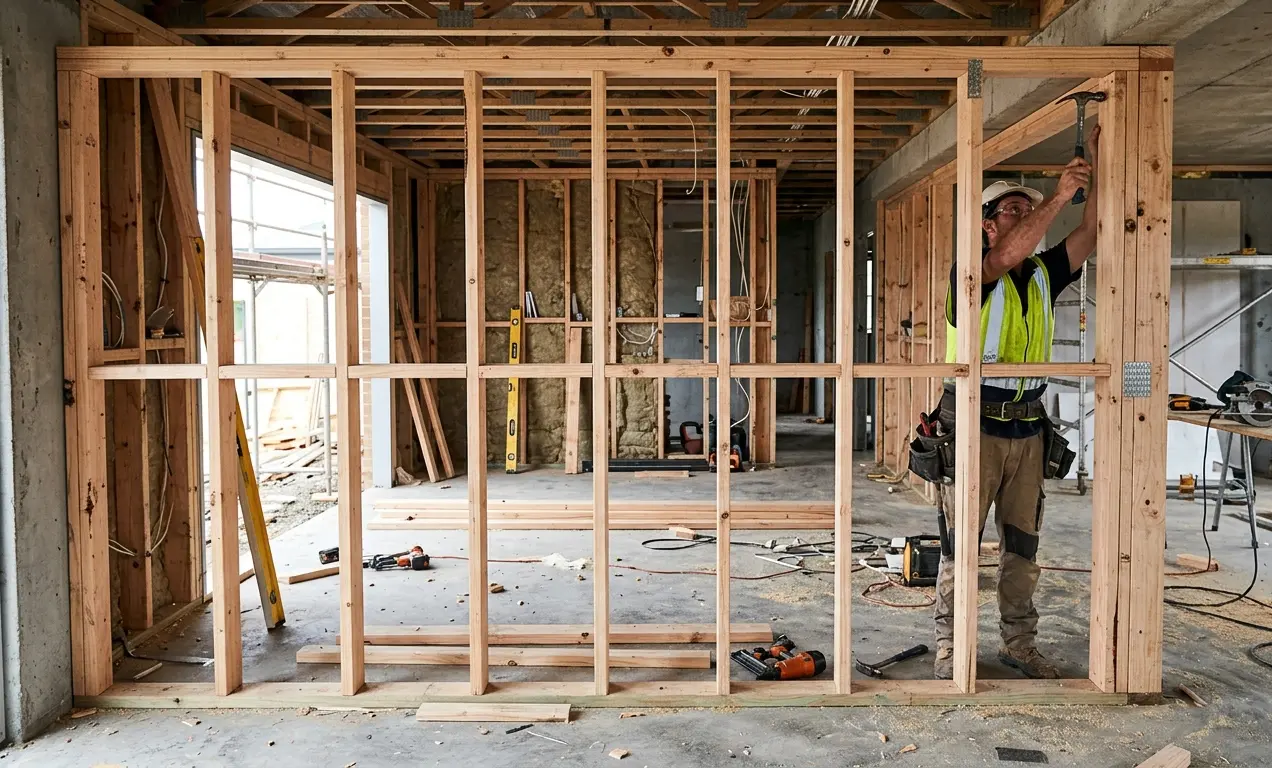
Worked Example: 3.6m Stud Wall at 400mm Centres
This example uses a 3600mm wall, 2400mm ceiling height, one row of noggins, and 3×2 CLS timber (actual size 75×47mm). Blade kerf is set to 3mm.
Step 1: The cut list
| Part | Length (mm) | Qty |
|---|---|---|
| Stud | 2306 | 10 |
| Top plate | 3600 | 1 |
| Bottom plate | 3600 | 1 |
| Noggin | 353 | 9 |
That is 21 individual pieces across 4 part types, enough that stock length choice makes a real difference to how many lengths you need to buy.
Step 2: Stock length comparison for studs
Studs at 2306mm are the dominant item. The optimiser compares all enabled stock lengths and shows which option requires the fewest pieces.
| Stock length | Studs per length | Lengths needed for 10 studs | Offcut per length |
|---|---|---|---|
| 2.4m (2400mm) | 1 | 10 | 91mm (waste) |
| 3.0m (3000mm) | 1 | 10 | 691mm (reusable) |
| 4.8m (4800mm) | 2 | 5 | 185mm (waste) |
Using 4.8m lengths cuts the stud purchase from 10 pieces down to 5: half the pieces to collect, carry and cut. That is not obvious until you run the numbers. The optimiser does it automatically across all your selected stock lengths.
Step 3: Full purchase summary
Running this wall through the optimiser with 4.8m studs, 3.6m plates and 2.4m noggins produces the following result:
| Stock | Lengths | What it covers |
|---|---|---|
| 3×2 CLS 4.8m | 5 | All 10 studs, 2 per length, 185mm offcut each |
| 3×2 CLS 3.6m | 2 | Top and bottom plates, exact fit, no waste |
| 3×2 CLS 2.4m | 2 | All 9 noggins: 6 from first length, 3 from second with a 1335mm reusable offcut |
Total: 9 lengths of 3×2 CLS to frame a 3.6m stud wall. The reusable 1335mm offcut from the noggin lengths is long enough to use elsewhere: for blocking, a small shelf, or the next job.
Why Stock Length Choice Matters
The most common mistake when buying stud wall timber is defaulting to the shortest available length. For studs at 2306mm, 2.4m lengths feel obvious, but they give only one stud each with 91mm of waste. Switching to 4.8m gives two studs per length with a similar offcut and halves the number of pieces you need to buy.
The same logic applies to every part of the frame. Plates at exactly 3600mm are a perfect match for 3.6m stock, giving zero offcut. Noggins at 353mm pack efficiently into 2.4m lengths, with a long reusable offcut from the final length.
A cut list calculator finds these combinations automatically. You enter the parts, enable a range of stock lengths, and the optimiser returns the result, including which offcuts are reusable and which are waste.
Walls with Door Openings
Door openings in a stud wall add extra members to the cut list: trimmer studs, a header (lintel), and sometimes cripple studs above the header. These all go into the same cut list alongside the regular studs, plates and noggins.
- Trimmer studs (jack studs): sit either side of the opening and support the header. Their length equals the opening height, not the full stud height.
- King studs: full-height studs that run from plate to plate at the edge of the opening. They are the same length as your regular studs, 2306mm in the example above.
- Header (lintel): spans the top of the opening. Its length equals the opening width plus the combined thickness of two king studs.
- Cripple studs: short studs that fill the space between the header and top plate, at normal stud spacing. Their length varies based on opening height and ceiling height.
Add these to the cut list as additional rows. The optimiser handles them the same way, finding the best fit from your available stock lengths, including kerf.
Free Plan vs Pro Plan for Stud Wall Jobs
A simple stud wall with no openings (like the 3.6m example above) has 4 cut rows in the optimiser and runs on the free plan without any restrictions.
Larger walls, walls with door openings, or jobs covering multiple walls add more cut rows quickly. Once you add trimmers, headers, king studs and cripple studs for even one doorway, a single wall can reach 8 or more distinct cut rows. The Pro plan removes row limits, unlocks PDF export for a workshop-ready cut sheet, and lets you compare multiple timber sizes in one run, useful when mixing 3×2 and 4×2 in the same wall frame.
Pro starts from £2 for a 3-day pass, which is less than the cost of one unnecessary length of CLS timber.
Tips for Accurate Stud Wall Planning
- Always include kerf. A 3mm saw kerf across 20+ cuts removes 60mm or more of material. This is enough to affect whether your last stud on a length fits correctly.
- Use actual CLS sizes. 3×2 CLS is nominally 75×50mm but the actual size is typically 75×47mm. Use the actual thickness (47mm) when calculating stud and noggin lengths, not the nominal size.
- Set a reusable offcut threshold. Any offcut above your threshold is flagged as reusable in the plan. Setting it to 300mm means offcuts shorter than 300mm are treated as waste, keeping the results practical.
- Enable multiple stock lengths. The optimiser can only compare lengths you enable. If you only enable 2.4m, it can only plan from 2.4m. Enabling 3.0m, 4.2m and 4.8m as well lets it find the best option across all of them.
- Label your parts. Using clear labels (Stud, Top Plate, Noggin) makes the cut plan easier to follow in the workshop, especially when lengths are similar.
- Plan all walls in one run. If you are framing multiple walls, adding all cut rows together gives the optimiser more scope to pack lengths efficiently across the whole job, not just one wall at a time.
Frequently Asked Questions
- How do I calculate stud length for a stud wall? Subtract the combined plate thickness from ceiling height. For a 2400mm ceiling and 47mm CLS plates: 2400 − 94 = 2306mm.
- How many studs do I need? Divide wall length by stud spacing and add one. For 3600mm at 400mm centres: 9 bays plus one end stud equals 10 studs.
- What is the best stock length for stud wall timber? It depends on your stud length. For 2306mm studs, 4.8m gives two studs per length, half as many lengths to buy compared to 2.4m. The optimiser compares all your enabled lengths and picks the most efficient combination.
- Does kerf matter for stud wall timber? Yes. At 3mm kerf and 20 or more cuts, you lose 60mm or more to sawdust. Include it to avoid running short on the last cut of a length.
- What timber size is used for stud walls? Most partition walls use 3×2 CLS (actual 75×47mm). Loadbearing walls or walls needing greater depth may use 4×2 CLS (actual 100×47mm).
- Can I use a free stud wall cut list calculator? Yes. The free plan covers linear timber optimisation with kerf, CSV export and on-screen results. The free plan is a good starting point for simple walls. Pro removes row limits and adds PDF export for more complex jobs.